
Working Memory: The Hidden Complexity Behind the Simple Model of Teaching
The second post in a series exploring memory and the Simple Model of Teaching

This post is the second in a short series about the Simple Model of Teaching.
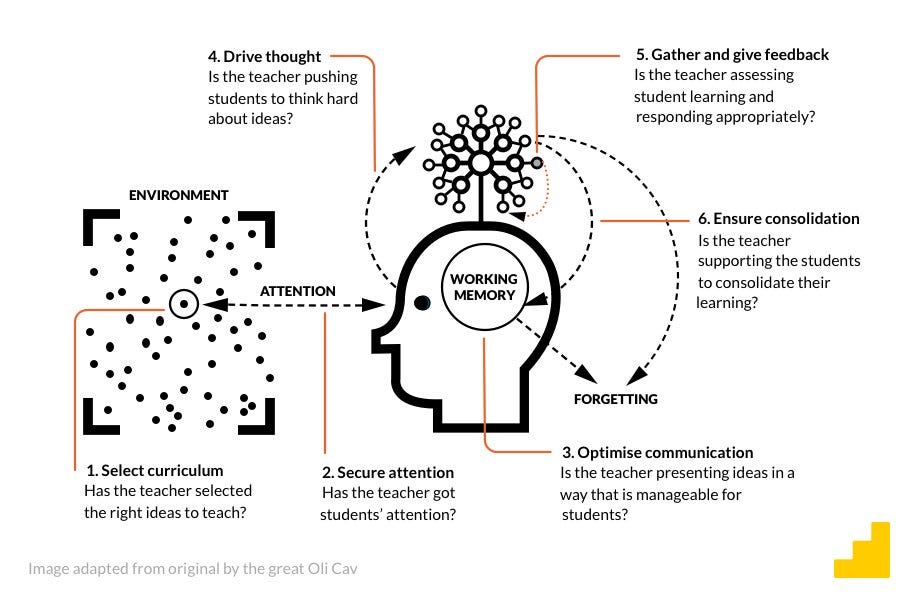
In my previous post, I explored short-term memory: the cognitive process that holds information briefly so that thinking can begin, and the one not labelled on Steplab’s Simple Model of Teaching (Figure 1).
But, this post will focus on one process that is labelled: working memory.
The fact that it’s labelled should make things simpler. But it doesn’t.
Despite being central to the diagram (nearly every arrow leads to or from it) there’s not consensus on how working memory…well…works.
This was a difficult post to write. There’s a lot of literature on working memory, and a number of competing models. So in this post, my aim is simply to sketch what it’s generally thought to involve - drawing on cognitive science and a bit of neuroscience - so we can better understand, and support, the pupils we teach.
In this field, scratch the surface and one model tends to lead to another.
It’s models all the way down.
What exactly is working memory?
Imagine this:
You’re taking your class on a trip to the zoo.
You’ve just stepped out of the butterfly house.
It’s warm, humid, and you’re recovering.
The pupils are lining up for the next enclosure.
You run a quick head‑count: twenty‑seven.
But you know there should be twenty‑eight.
You scan the group and picture where they stood a minute ago. That mental snapshot relies on your visuospatial sketchpad: the part of working memory that holds visual and spatial information.
As you count again, you whisper their names to yourself (Ella, Leo, Judah …) using your phonological loop, which maintains verbal information.
Meanwhile, your central executive runs the show: staying focused, switching strategies, holding back the urge to shout, “Who’s missing?”
It’s Ava, now sprinting up with a butterfly perched triumphantly on her finger.
You breathe out, relieved.
Baddeley and Hitch’s model of working memory
The headcount in the butterfly house didn’t rely on a single ‘box’ in the brain.
It drew on a set of temporary systems, each doing something slightly different: visual, verbal, and attentional.
This is the core idea behind one of the most influential models of working memory proposed by Baddeley and Hitch in the 1970s. Earlier models proposed that information would make its way into long-term memory if it just sort of brewed in short-term memory long enough, as if time alone would do the work…like a good cup of tea (which I hope you’re drinking as you read this).
But evidence pointed to the contrary.
And so Baddeley and Hitch (1974) argued that working memory isn’t a single store, but a system of components….a process, as displayed in Figure 2:
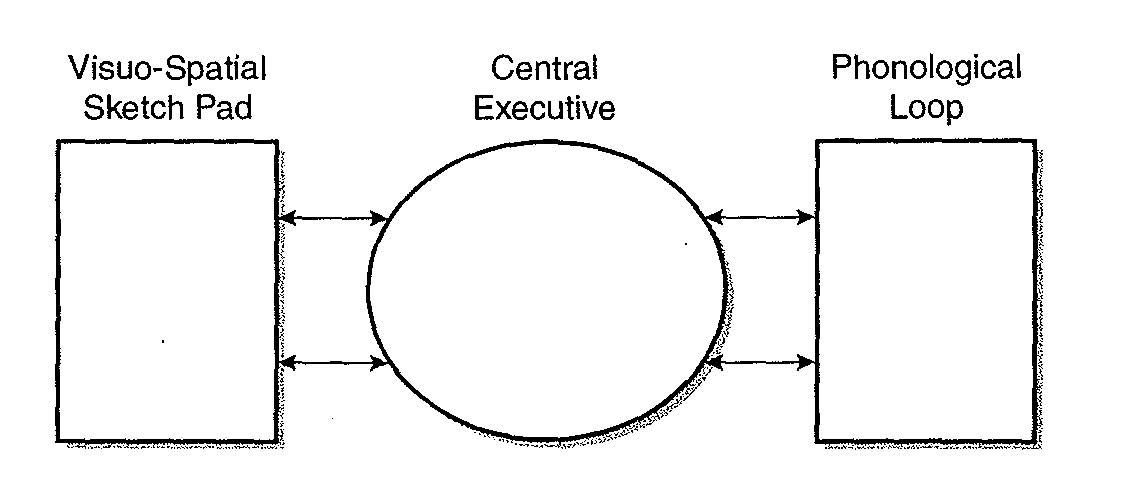
Phonological loop holds verbal or auditory information for a few seconds and refreshes it through rehearsal
Visuospatial sketchpad stores what’s seen and where it is
Central executive is not a store, but a controller: it shifts attention, switches strategies, and manages the flow of information across the system. It has, however, been criticised for being a bit homunculus…y
This framework doesn’t explain everything, especially not how attention actually works, or how meaning is integrated, but it’s a useful starting point. It helps us name & consider the different types of load we’re asking pupils to carry.
Sadly, it’s not that simple
Think back to Ava’s butterfly.
You likely pictured a whole butterfly and not separate patches of colour, shape, and motion. You may have had a visual image, an emotional response, even a flicker of memory. Unless, of course, you have aphantasia…in which case, your mental recall may have taken another form entirely.
The point is: how does the brain bind all these features…visual, emotional, spatial…into a single, coherent image?
This is known as the binding problem, and it’s still unresolved. For years, it challenged the original three-part model of working memory. Neither the phonological loop nor the visuospatial sketchpad could explain how we combine different types of information, or why we recall meaningful sentences more easily than lists of random words.
To address this, Baddeley (2000) introduced a fourth component to the model: the episodic buffer. It’s a temporary store that integrates information from different sources into a unified whole.
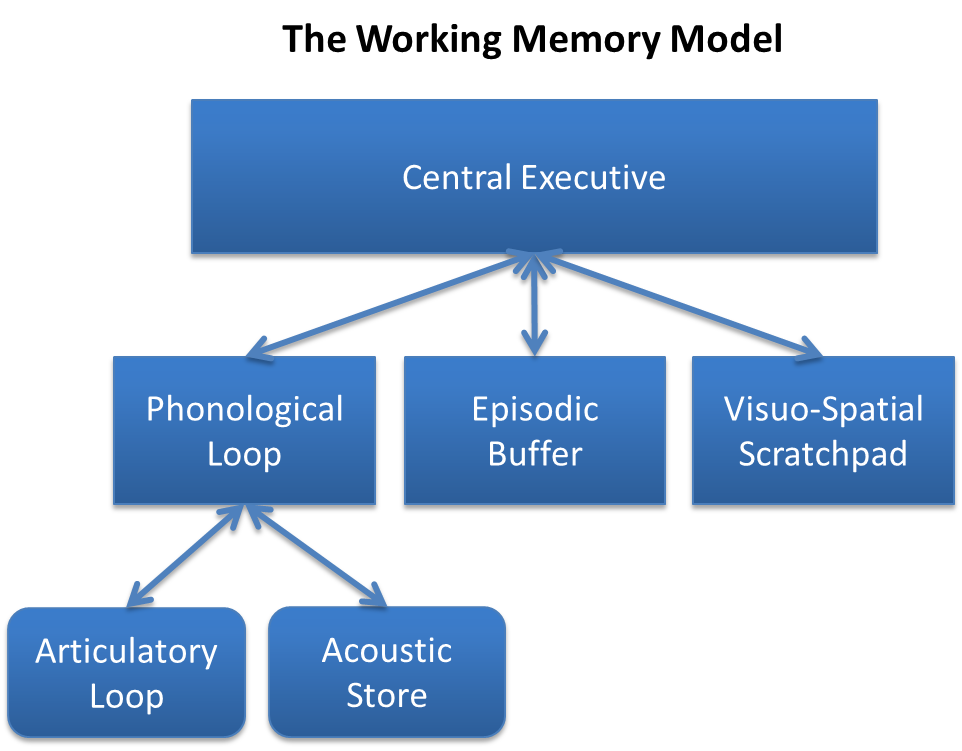
Initially thought to be controlled by the central executive, later research suggests that binding may emerge from more domain-specific processes, such as visual attention or language networks, rather than from a single overseer.
Where does that leave us? With a complex system, still under study. But with a clearer sense that working memory draws on multiple systems, each with its own limits, and that integration isn’t effortless.
And that has consequences.
Can pupils multitask?
You might think you’re good at it…and maybe you are. But statistically, frequent multitaskers are more distractible, not less. They tend to spread their attention more broadly, but with less control over where it lands.
Multitasking may feel efficient. But it comes at a cost, even for adults. For children whose working memory systems are still developing, the cost is often higher and recovery slower.
We often assume pupils can juggle multiple streams: write while listening, read while someone talks, take in new instructions mid-task. Why else would we keep talking as we set them off to work?
But, no, they can’t.
As we’ve seen, the most influential model of working memory involves separate systems including the phonological loop, the visuospatial sketchpad, the central executive. These can function in parallel, but when two tasks rely on the same system, they tend to interfere.
It’s why reading text from a PowerPoint whilst trying to listen to something different being said is so difficult. You focus on one or t’other. Both use the phonological loop. The same system is trying to process two streams at once.
Studies on dual-task performance show that the more similar two tasks are (in modality or response type) the more likely they are to compete. It’s why we can drive and sing (or try to…), but not drive and text. A pupil holding a sentence in mind while writing it down, and then being spoken to mid-task? Something gets lost, not through lack of effort, but because the system is overloaded.
In short, shared resource = more interference.
Separate resource = more manageable…but still not risk-free if one task becomes demanding (why people may stop singing when trying to park).
In practice, multitasking often means task-switching. And switching interrupts encoding, fragments attention, and displaces what was already held in mind.
This matters even more for pupils with EAL, pastoral needs, ADHD or dyslexia, who may already be rehearsing more, retrieving more slowly, or compensating for reduced working memory capacity.
For these pupils, an interruption isn’t a gentle redirection. It’s an eviction.
So the rule of thumb holds:
Break tasks into steps. Avoid talking over writing, reading, or movement.
Not just for clarity, but to preserve the scarce workspace they’re already using to think.
And sometimes, that workspace is under pressure before we even begin.
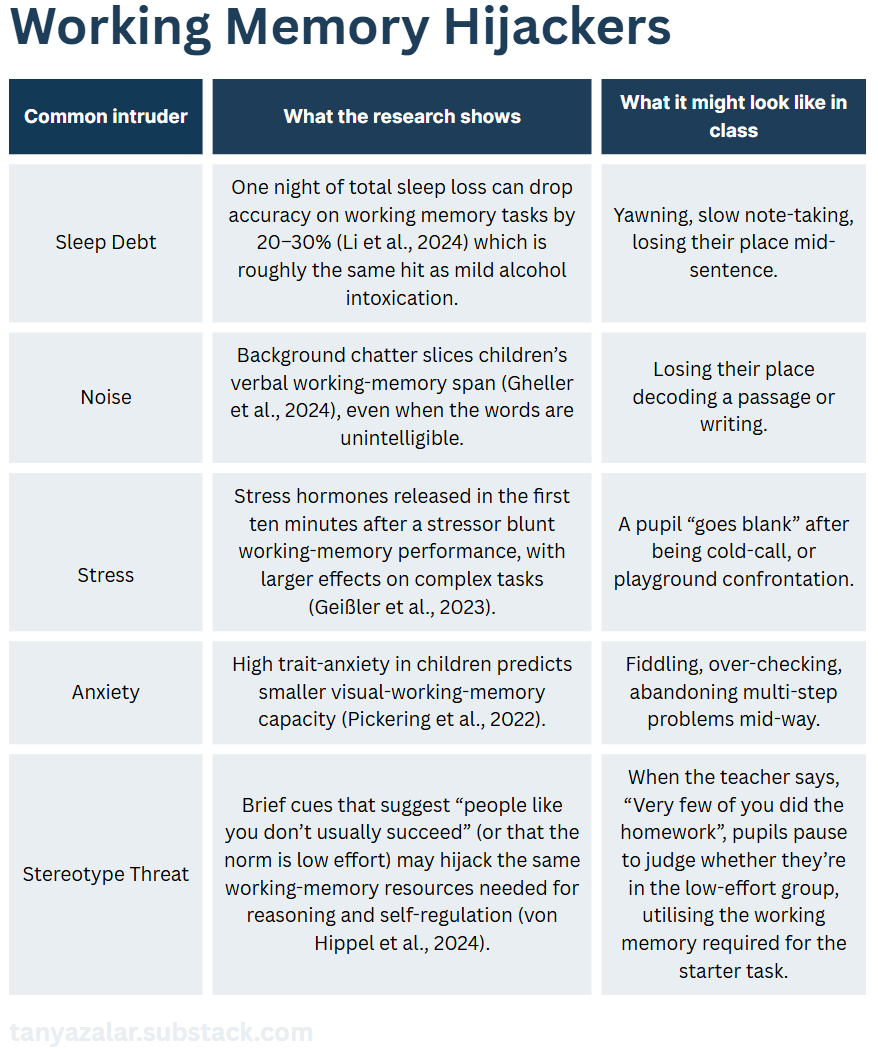
Working Memory Hijackers
Working memory isn’t just limited - it’s vulnerable.
Imagine trying to work from a tiny desk.
Now add clutter.
Below are five common intrusions, drawn from recent research, and what they might look like in the classroom.
What does neuroscience add?
It confirms what many teachers sense: working memory isn’t just limited…it’s fragile.
Neuroscience shows that working memory depends on a network of brain regions working together. The prefrontal cortex helps us hold and manipulate information; the parietal cortex helps direct attention and spatial awareness. These areas don’t work alone…they’re supported by subcortical structures such as the basal ganglia, thalamus, and cerebellum. When any part of that system is overloaded, whether that’s by noise, stress, or ‘multitasking’, performance drops.
Importantly for children, this network is still developing. The neural connections involved in working memory are slow to mature. The pathways that support attention and control are among the last to fully myelinate. This means children's capacity isn’t just smaller than adults'.
It's more easily disrupted.
Neuroscience also helps explain why information sometimes “comes back” with a cue. Some memories are kept active by ongoing brain activity, but others are held in a quieter, background state…still there, but harder to access without support. A calm prompt can reactivate what seemed lost; a sudden interruption can wipe it out completely.
So while cognitive models describe what working memory does, neuroscience helps us understand why it’s so sensitive and why some pupils may need more time, space, and support just to keep a thought in mind.
Where does this leave us?
This was a difficult post to write.
Working memory sits at the centre of the Simple Model of Teaching (Figure 1). Almost every arrow points to or from it, and yet it really & truly resists simple description. It’s not one thing, or in one place. It isn’t neatly bounded, nor fully agreed upon. There are competing and conflicting models, overlapping systems, and findings that clarify and complicate in equal measure. A great deal has been left out.
But that’s been kind of deliberate. The goal here wasn’t to cover everything. It was to look beyond the label and sketch what working memory broadly involves and to, hopefully, make it easier to teach with it in mind.
Because if we treat working memory as a single box in the model, we risk missing what’s inside it: the juggling, the rehearsal, the effort, the load. The pupils.
The model moves on from here: to practice, to retrieval, to long-term memory, to forgetting. It’s important to remember that working memory isn’t a passing step though. It’s the workspace of learning, and it needs protecting.
References
Baddeley, A.D., & Hitch, G. (1974). Working memory. In G.H. Bower (Ed.), The psychology of learning and motivation: Advances in research and theory (Vol. 8, pp. 47–89). New York: Academic Press.
Baddeley A. (2000). The episodic buffer: a new component of working memory?. Trends in cognitive sciences, 4(11), 417–423. https://doi.org/10.1016/s1364-6613(00)01538-2
Chai, W. J., Abd Hamid, A. I., & Abdullah, J. M. (2018). Working memory from the psychological and neurosciences perspectives: A review. Frontiers in Psychology, 9, Article 401. https://doi.org/10.3389/fpsyg.2018.00401
Geißler, C. F., Friehs, M. A., Frings, C., & Domes, G. (2023). Time-dependent effects of acute stress on working memory performance: A systematic review and hypothesis. Psychoneuroendocrinology, 148, 105998. https://doi.org/10.1016/j.psyneuen.2022.105998
Gheller, F., Spicciarelli, G., Scimemi, P., & Arfé, B. (2024). The Effects of Noise on Children’s Cognitive Performance: A Systematic Review. Environment and Behavior, 55(8-10), 698-734. https://doi.org/10.1177/00139165241245823 (Original work published 2023)
Jiahui Li, Yixuan Cao, Simei Ou, Tianxiang Jiang, Ling Wang, Ning Ma, The effect of total sleep deprivation on working memory: evidence from diffusion model, Sleep, Volume 47, Issue 2, February 2024, zsae006, https://doi.org/10.1093/sleep/zsae006
Ma, W. J., Husain, M., & Bays, P. M. (2014). Changing concepts of working memory. Nature neuroscience, 17(3), 347–356. https://doi.org/10.1038/nn.3655
Mccrea, P. (2024, January 17). A simple model of teaching [Tweet]. Twitter/X. https://twitter.com/PepsMccrea/status/1747685287633086862 Image adapted from original by Oli Cav.
Pickering, H. E., Parsons, C., & Crewther, S. G. (2022). The effect of anxiety on working memory and language abilities in elementary schoolchildren with and without additional health and developmental needs. Frontiers in Psychology, 13, Article 1061212. https://doi.org/10.3389/fpsyg.2022.1061212
von Hippel, C., Kühner, C., Coundouris, S. P., Lim, A., Henry, J. D., & Zacher, H. (2024). Stereotype Threat at Work: A Meta-Analysis. Personality and Social Psychology Bulletin, 0(0). https://doi.org/10.1177/01461672241297884